Yu Gao, Baihui Wang, Mengnan Li, Yun Qiu, Siyi She, Ling Zhang, Xiaoming Zou, Honghua Ruan
2026, 19 (5): rtag022.
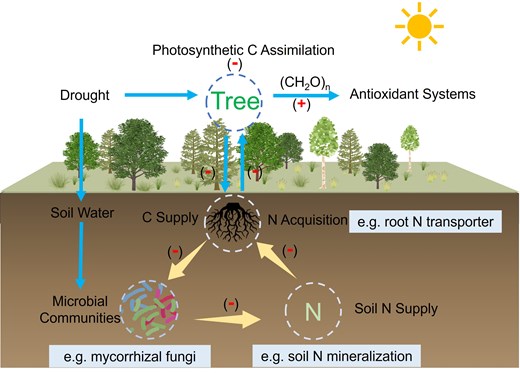
Drought stress significantly constrains plant growth and terrestrial ecosystem productivity by disrupting the synergistic interplay between carbon (C) assimilation and nitrogen (N) cycling. This review synthesized evidence for a multi-tiered “C-N dual limitation” feedback loop under drought conditions, driven by the following key mechanistic disruptions: (1) impaired photosynthetic C assimilation due to combined stomatal and non-stomatal limitations; (2) suppressed soil N mineralization and reduced root N uptake; (3) drought-driven shifts in microbial community structure that weaken organic N mobilization and mycorrhizal nutrient transport; and (4) a metabolic tradeoff in energy allocation, whereby Adenosine Triphosphate (ATP) and Nicotinamide Adenine Dinucleotide Phosphate Hydrogen (NADPH) are diverted from growth to antioxidant defense. To unravel the complexity of this C-N imbalance, we addressed three pivotal issues: (1) to dissect the interactive regulation of physiological, metabolic, and molecular processes that reinforce the feedback loop; (2) to contrast the C-N coordination strategies across C3, C4, and Crassulacean Acid Metabolism (CAM) plants, linking these differences to divergent drought resilience; (3) to evaluate pathways to mitigate this limitation, ranging from the targeting of key regulatory hubs such as TOR/SnRK1 and ABA-ROS signaling, to leveraging of rhizosphere microbial ecology, and to discuss their integration into predictive models. By integrating current insights, this review presents a coherent framework for understanding plant drought resistance and proposes actionable strategies for sustainable ecosystem management in a changing climate.
This review synthesizes the mechanisms underlying carbon nitrogen dual limitation in plants under drought stress, emphasizing a self reinforcing feedback loop between impaired photosynthesis and nitrogen uptake, and discusses adaptive strategies across plant functional types along with potential mitigation approaches.
Hanyu Yao, Zihao Li, Wenxin Liu, Binglin Guo, Zhenjiang Li, Zhipei Feng, Huifang Wu, Guanqin Wang, Qiang Li, Deliang Kong, Qingpei Yang
2026, 19 (5): rtag103.
Seed mass is a key trait influencing plant form and function. It reflects parental resource investment and influences seedling growth as well as the construction of root and leaf organs. However, how seed mass regulates root and leaf functional traits in legume species remains unclear. In this study, we selected 16 common herbaceous legume species growing in pots. The results showed that seed mass exhibited a U-shaped quadratic relationship with both fine root diameter and fine root biomass. Seed mass was significantly positively correlated with single leaf area, specific leaf area and stomatal length. However, it showed no significant correlation with leaf nitrogen concentration, leaf vein traits or stomatal density. Meanwhile, the relationships between seed and root traits and between seed and leaf traits in these legume species were markedly different from those reported for global non-nitrogen-fixing plants. These results indicate that seed mass may selectively regulate certain root and leaf traits. These findings provide a new perspective for understanding the formation of life history strategies in legumes and their responses and adaptations to environmental change.
Hongjiao Hu, Xinping Liu, Yuhui He, Jiaqi Jing, Yao Zhang
2026, 19 (5): rtag002.
Precipitation legacy effects (PLEs) profoundly alter the recovery trajectories of semi-arid grasslands under global climate change, necessitating mechanistic quantification for accurate climate risk assessment in these vulnerable ecosystems. Based on a 7-year precipitation simulation experiment followed by an in situ natural recovery study in a semi-arid sandy grassland in Inner Mongolia, China, we characterized PLEs across multiple ecological hierarchies and varying precipitation patterns using data from the final treatment year and the first post-treatment year. Our results demonstrated that vegetation traits exhibited stronger PLEs than soil physicochemical properties. The magnitude of PLEs increased with higher functionalization (composition → productivity) and finer hierarchy (community → functional group), exceeding 50% when significant. Dry PLEs were generally stronger than wet PLEs; both exhibited bidirectional (positive/negative) performance, yet consistently showed an inverse relationship between vegetation traits and trait resilience. Mechanistically, PLEs of moderate wetting and extreme drying were primarily carried by vegetation-mediated information, whereas PLEs of moderate drying and spring drought legacies were mainly carried by soil-mediated material. Specifically, functional group composition served as the key information carrier: annuals primarily carried positive dry PLEs and negative wet PLEs, while perennials carried the opposite PLEs; and the prevalent negative PLEs in community-level productivity and species diversity were specifically attributed to perennial grasses expansion after drying and annual forbs expansion after wetting. Soil available nutrients acted as the key material carrier, promoting PLEs in annuals via synergistic physicochemical pathways. Overall, both dry and wet PLEs generally impeded the vegetation recovery of the sandy grassland ecosystem, despite positive effects on certain finer-hierarchy ecosystem traits. We conclude that ignoring PLEs may lead to a severe underestimation of climate change risks in semi-arid ecosystems, particularly regarding their most sensitive components.
Qian Wu, Xin Ju, Ai-Min Zhu, Xiao-Jia Zhang, Hai-Yan Ren, Guo-Dong Han
2026, 19 (5): rtag100.
Soil microbial necromass carbon (MNC), a critical component of soil organic carbon (SOC), plays a vital role in the formation and stabilization of SOC. Climate warming and increased atmospheric nitrogen (N) deposition are key factors influencing carbon sequestration in grassland ecosystems. However, the impacts of warming and N deposition, as well as their interactions, on soil MNC in arid grasslands remain poorly understood. In this study, we investigated soil MNC, including fungal necromass carbon (FNC) and bacterial necromass carbon (BNC), following a continuous 16-year manipulation of warming and N addition in a desert steppe in Inner Mongolia, China. We also analyzed these parameters in conjunction with soil microbial diversity, plant coverage and soil properties. The results showed that N addition significantly increased soil MNC and FNC, as well as fungal diversity while not affecting BNC or bacterial diversity. Warming did not significantly affect MNC (including both FNC and BNC) or soil microbial diversity and there was no interactive effect between warming and N addition. Soil MNC, FNC and BNC were found to be higher in the topsoil layer than in the subsoil layer, and FNC contributed more to SOC than BNC. Notably, the increase of soil MNC and FNC under N addition was mainly mediated by increased soil N content. This study clarifies the critical role of MNC in soil carbon storage and offers an empirically grounded basis for forecasting grassland carbon changes under future global change scenarios.

 Volume 19 Issue 5