
-
In this post, Nan Wang from the State Key Laboratory of Hydraulics and Mountain River Engineering at Sichuan University provided an in-depth discussion and shared insights on the paper “Divergent responses of vegetation phenology and productivity to climate change in typical river basins across Northern and Southern China,” published in the Journal of Plant Ecology.
Why study climate, phenology and productivity in the Yangtze and Yellow River basins?
As global climate change accelerates, the response of terrestrial ecosystems has drawn widespread attention, particularly regarding the link between vegetation phenology and productivity. The Yangtze River Basin (YZRB) and the Yellow River Basin (YRB) are the two largest river basins in China, representing the distinct climatic patterns of the humid South and the arid/semi-arid North. Vegetation phenology, such as the start (SOS) and end (EOS) of the growing season, acts as a sensitive "biological clock" that regulates the exchange of carbon and water between the land and atmosphere. While it is well known that warming generally extends the growing season, a critical question remains: do ecosystems in such contrasting climatic zones respond to these changes in the same way? Understanding how climate factors differentially drive phenology and subsequently affect Net Primary Productivity (NPP) is essential. This comparison is not just of academic interest; it provides the scientific basis for region-specific carbon management and is crucial for maintaining the ecological security barriers of China’s two "Mother Rivers."
What are the findings of this study?
Our study showed that, from 2000 to 2019, annual net primary productivity (NPP) increased in both basins, albeit through distinct climatic–phenological pathways. In the Yangtze River Basin (YZRB), the length of the growing season increased by 0.60 days yr⁻¹ (P < 0.05), primarily due to an advance in the start of the growing season (SOS). This phenological shift was associated with an annual NPP increase of 3.19 g C m⁻² yr⁻¹, with more than half of the gain occurring in spring. In the Yellow River Basin (YRB), NPP increased at a slightly higher rate (3.54 g C m⁻² yr⁻¹), but seasonal contributions were more evenly distributed, and water availability emerged as the dominant constraint. In this water-limited system, precipitation regulates NPP both directly and indirectly via its influence on phenology, such that productivity depends critically on the temporal synchronization between rainfall events and the vegetation growth window. Taken together, these results delineate an energy-driven regime in the humid South and a water-limited, precipitation-synchronized regime in the North, highlighting the need for region-specific strategies to enhance terrestrial carbon uptake.
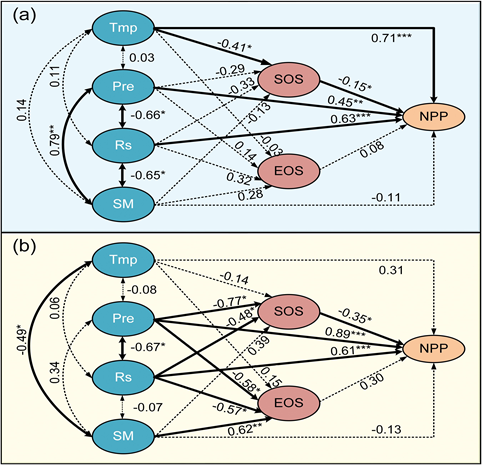
Figure: Climate–phenology–NPP relationships in the Yangtze and Yellow River Basins
Some views on ecological research
Ecological research is like decoding the complex language of the earth, and phenology serves as the "pulse" of the ecosystem. Imagine the river basins as living organisms: the Yangtze and Yellow Rivers are their arteries, and the vegetation is their skin. The seasonal green-up and browning are their rhythmic breaths. Studying these large-scale patterns reminds us that nature does not have a "one-size-fits-all" solution. The beauty of ecology lies in this diversity and adaptation. By observing how these vast ecosystems adjust their biological clocks in response to a warming world, we not only gain scientific knowledge but also learn to respect the unique "wisdom" of nature in different regions. This understanding is the foundation for humans to coexist harmoniously with the environment.
About the author

Nan Wang
I am a Ph.D. candidate at the State Key Laboratory of Hydraulics and Mountain River Engineering, Sichuan University. My research focuses on how global climate change and hydraulic engineering reshape river basin ecosystems. I draw on both terrestrial and aquatic ecology to evaluate the impacts of dam construction on riverine environments. Using satellite remote sensing with hydrological and ecological datasets, I quantify how altered climate regimes and dam operations affect vegetation dynamics—such as NDVI, phenology and productivity—as well as river morphology and fish habitats. Through this work, I aim to develop integrated assessments of ecosystem health that can inform more sustainable management of large river basins.
If you are interested in more details about the study, please read our paper “Nan Wang, Ayong Jiao, Yingjun Xu, Yacun Yang, Nan Cong*, Weiwei Yao*, Divergent responses of vegetation phenology and productivity to climate change in typical river basins across Northern and Southern China” published in Journal of Plant Ecology (https://doi.org/10.1093/jpe/rtaf080).
CiteScore: 6.3
Yuanhe Yang
Bernhard Schmid
ISSN 1752-9921(print)
ISSN 1752-993X(online)