
-
In this new post, Associate Professor Tiantian Lin and Professor Bo Li from Yunnan University provided an in-depth discussion and shared insights on the paper “Soil microbe-induced plant volatiles can alert neighboring plants to heavy metal stress” recently published in the Journal of Plant Ecology.
Why is it necessary to study the alerting effect of volatile substances from invasive plants?
Invasive plants and soil microorganisms exist highly complex and dynamic interaction relationship. On the one hand, invasive plants significantly promote their own growth and development, enhance their defense capabilities and environmental adaptability by establishing symbiotic relationships with beneficial microorganisms. On the other hand, pathogenic microorganisms can seriously damage the normal growth and reproduction of invasive plants. It is worth noting that the plant-microbe interaction significantly affects the release characteristics of plant VOCs, forming unique microbe-induced plant volatiles (MIPVs). Given that invasive plants generally establish special symbiotic relationships with soil microorganisms, a key scientific question is: Can soil microbial communities regulate the "odor" of invasive plants?
Kalske et al. (2022) innovatively extended the MIPVs defense theory into the field of invasion ecology. Their research found that the MIPVs signals produced by the invasive plant Lupinus polyphyllus, under the induction of soil microorganisms in the invaded area, could effectively repel herbivorous snails in the invaded area, thereby significantly reducing herbivory damage. This discovery provides a new perspective for understanding the chemical defense mechanisms of invasive plants. However, current research on VOCs of invasive plants still mainly focuses on their direct defense functions for the releasing plants themselves, which is closely related to the enemy release hypothesis. In fact, as an important component of induced VOCs, MIPVs play a key role in plant-plant communication(PPC), serving as carriers of stress signals to induce neighboring plants to produce defense responses, such as enhancing resistance to pathogens. Regrettably, this important function of MIPVs in PPC has not received due attention in invasion ecology research.
What are the findings of this study?
Under heavy metal stress, the MIPVs of the invasive plant Phytolacca americana can induce a series of physiological responses in neighboring plants: (1) a significant increase in salicylic acid (SA) levels; (2) a decrease in auxin (IAA) content; (3) a shift in ecological strategy towards stress-tolerant (S) strategy. The manganese stress tolerance experiment confirmed that plants pre-treated with MIPVs could maintain a better growth state under stress conditions and showed a lower level of oxidative damage. Notably, under sterile conditions, the VOCs induced by simple manganese stress alone could not trigger the early warning response of neighboring plants. This finding emphasizes that a complete soil microbial community is a necessary condition for MIPVs to produce effective early warning effects, providing a new perspective for understanding the ecological mechanism of chemical communication between invasive plants.
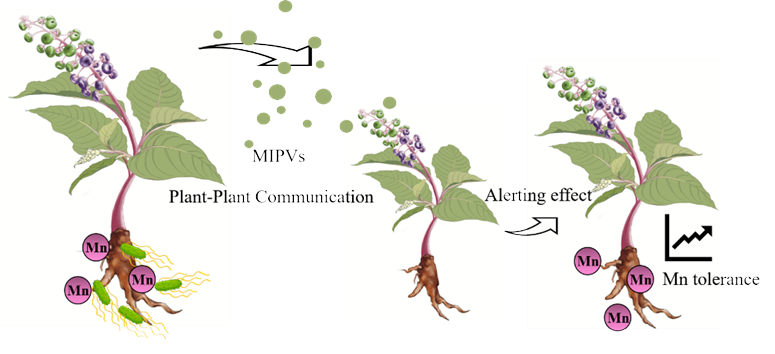
The warning effect of the regulation of manganese stress from adjacent plants by the volatiles of Phytolacca americana
Some views on the study of volatiles in Invasion ecology
VOCs may influence the growth state of neighboring plants by regulating their hormone levels. This hypothesis provides a new explanation for the phenomenon observed by previous researchers: the growth inhibitory effect of VOCs on neighboring plants may result from growth regulation rather than direct toxicity, as the concentration of biogenic VOCs in natural environments is usually far from reaching the toxicity threshold. Additionally, in previous studies, invasive plants have higher biomass or greater coverage per unit area than native plants, which provides a material basis for their release of high-intensity VOCs. In the local communication network, invasive plants are more likely to act as donors rather than recipients of VOCs, thus occupying a dominant position.
About the author

Jieren Jin
My research mainly focuses on invasion ecology, exploring the effects of various environmental and microbial factors on the growth of invasive plants. During my doctoral studies, I particularly paid attention to the role of volatile substances released by invasive plants under heavy metal stress on the plants themselves and their neighboring plants. Based on long-term greenhouse experiments and comprehensive analysis, I systematically revealed the ecological functions of invasive plant volatiles under heavy metal stress, providing scientific basis for the control of invasive plants.
If you are interested in more details about the story, please read our paper “Jieren Jin, Tiantian Lin*, Chaonan Wang, Xiao Xu, Danfeng Liu, Yi Wang, Yupeng Geng, Rui-Ting Ju, Ming Nie*, Bo Li*. Soil microbe-induced plant volatiles can alert neighboring plants to heavy metal stress” published in Journal of Plant Ecology (https://doi.org/10.1093/jpe/rtaf065).
CiteScore: 6.3
Yuanhe Yang
Bernhard Schmid
ISSN 1752-9921(print)
ISSN 1752-993X(online)