
-
In this post, Dr. Yang Liu and Prof. Enqing Hou from the South China Botanical Garden, Chinese Academy of Sciences, discuss and share insights from their recent publication, “Contrasting responses of plant and soil microbial diversity to altered phosphorus supply”, in the Journal of Plant Ecology.
Why study the impact of phosphorus supply on biodiversity?
Phosphorus, an indispensable nutrient for plant growth, stands as a cornerstone within global biogeochemical cycles. As agricultural intensification fuels an ever-increasing demand for fertilizers, excessive phosphorus inputs have escalated into a pervasive environmental concern. Over-fertilization can trigger eutrophication in aquatic systems and may profoundly reshape both plant communities and soil microbial assemblages. However, despite extensive research on phosphorus's effects on plant productivity, its impact on biodiversity remains inadequately explored, representing a crucial gap in our understanding.
In natural ecosystems, plants and soil microbes engage in intricate exchanges through complex, interconnected networks that govern ecosystem functioning. Consequently, shifts in phosphorus availability possess the profound capacity to reshape both the structure and vital functions of these intertwined communities. Elucidating how above- and belowground organisms respond to altered phosphorus supply is therefore paramount—it unlocks the fundamental mechanisms driving ecosystem processes and provides indispensable insights for guiding effective land management and ecological restoration. To bridge these critical knowledge gaps, our research uniquely combined a global meta-analysis with a natural gradient approach, meticulously investigating the contrasting responses of plant and soil microbial diversity to changes in phosphorus availability.
What are the key findings of this study?
By compiling a global database of phosphorus-addition experiments, we revealed that phosphorus addition significantly reduced plant species richness in grasslands, while soil microbial diversity remained remarkably resilient across grassland, forest, and cropland ecosystems (Fig. 1). Subgroup analyses and within-site comparisons consistently demonstrated that plant diversity is strikingly more sensitive to phosphorus enrichment than microbial diversity (Fig. 2 and Fig. 3). Leveraging published datasets on global forest tree and vascular plant richness, alongside climatic and soil physicochemical variables, robust generalized linear models and partial correlation analyses further uncovered distinct shifts in plant diversity along soil total phosphorus gradients (Fig. 4). The compelling convergence of evidence across these complementary approaches provides compelling evidence that plant diversity responds far more strongly than soil microbial diversity to changes in phosphorus availability.
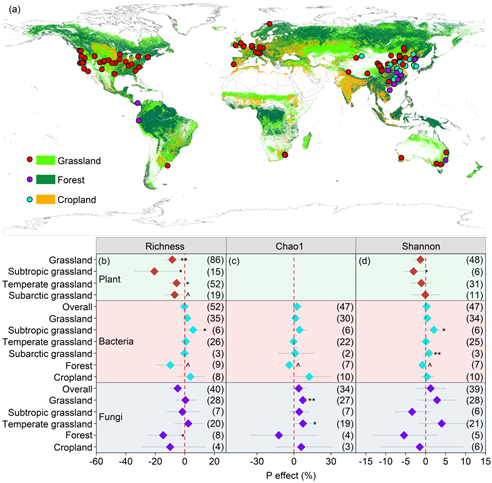
Fig.1 Global distribution of phosphorus-addition experimental sites (a) and effects of phosphorus addition on plant and microbial diversity across major ecosystem types (b–d).
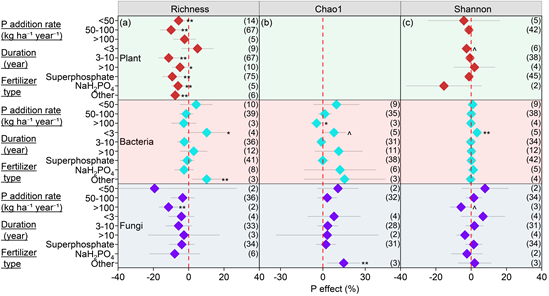
Fig.2 Effects of phosphorus addition on biodiversity across different experimental designs.
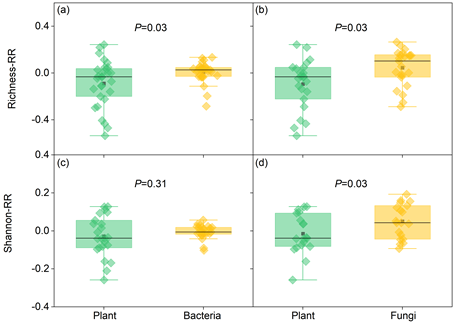
Fig.3 Contrasting response ratios of species richness and Shannon diversity among plant, bacterial, and fungal communities under phosphorus addition.
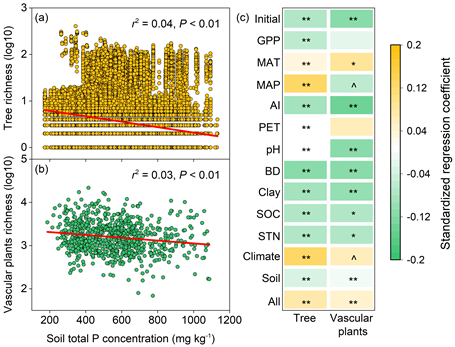
Fig. 4 Global patterns linking soil total phosphorus with species richness of forest trees and vascular plants.
Some views on ecological research
Phosphorus, a nutrient essential for plant growth, acts as a "hidden key" within ecosystems, quietly unlocking life processes and driving nutrient cycles. As global agriculture intensifies and phosphorus fertilizer use escalates, the availability of this vital element is undergoing subtle shifts, prompting strikingly different responses from plants and soil microbes. Our analysis of a global database of phosphorus-addition experiments and natural gradient studies reveals that plant diversity reacts profoundly to phosphorus changes—growth surges, vibrant blooms, and reproduction pulse through ecosystems like a beating heart. In stark contrast, soil microbes exhibit remarkable stability, operating behind the scenes within complex underground networks to maintain balance and resilience.
These divergent responses unveil two distinct rhythms of life. Plants react swiftly and visibly to environmental shifts, while microbes buffer disturbances with quiet, steadfast guardianship. The sensitivity of plants underscores how ecosystem structure and function can transform rapidly with nutrient fluctuations, whereas microbial stability demonstrates the inherent resilience and self-regulation woven into natural systems. By observing these "echoes of life," we gain deep insight into how phosphorus sculpts plant and microbial communities, witnessing the profound wisdom with which ecosystems navigate global change. Even subtle shifts in phosphorus availability act like precise musical notes, composing a grand symphony of life where plants and microbes are exquisitely intertwined. Through the lens of science, we can listen to and interpret this symphony—feeling nature's enduring resilience while uncovering the intricate, exquisite mechanisms that sustain our world.
About the Authors

Yang LiuPostdoctoral researcher at the South China Botanical Garden, Chinese Academy of Sciences. Research focuses on global change ecology and soil ecology. Published seven papers as the sole first author in international and domestic journals, including Ecology and Global Change Biology. Enqing HouResearcher and doctoral supervisor at the South China Botanical Garden, Chinese Academy of Sciences. Research focuses on terrestrial carbon and phosphorus cycling. Led several projects funded by the National Natural Science Foundation of China (NSFC), including the Youth Science Fund Project (Category B) and General Program projects. Published over 100 research papers in journals such as Nature Communications and Nature Food, cited more than 7,000 times. Serves on the editorial boards of Fundamental Research, Global Change Biology, and Journal of Plant Ecology.
If you are interested in more details about the story, please read our paper “Yang Liu, Mei He, Huijun Ye, and Enqing Hou*. Contrasting responses of plant and soil microbial diversity to altered phosphorus supply” published in Journal of Plant Ecology (https://doi.org/10.1093/jpe/rtf079).
CiteScore: 6.3
Yuanhe Yang
Bernhard Schmid
ISSN 1752-9921(print)
ISSN 1752-993X(online)